
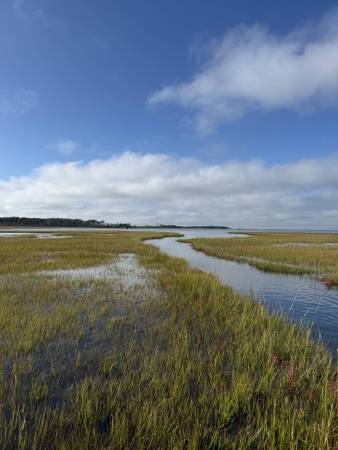
Whether you are an avid birdwatcher trying to get a glimpse of the elusive Saltmarsh Sparrow, an eager crabber trying to get a bushel of #1’s to steam up for dinner, or a passionate artist trying to capture the intrinsic beauty of our watershed, you share a common interest in protecting our salt marshes. Salt marshes are incredibly important to both humans and our environment as they provide numerous ecosystem services. They help mitigate flooding events caused by storms and high tide events, they act as a buffer to our bays by helping to filter runoff carrying excess nutrients and pollutants, they store carbon, and provide habitat to many species in our watershed. Unfortunately, there are several threats that are causing us to lose salt marsh habitat throughout our watershed. Sea level rise, erosion caused by wave energy, development and hardening of shorelines are just a few of the reasons our salt marshes are disappearing at an alarming rate.
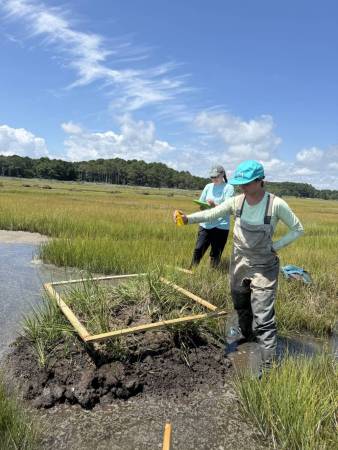
For many years now, MCBP has collaborated with numerous local, state, and federal partners to discuss ways we can address this issue through prioritizing salt marsh habitats in our watershed, scientific monitoring, research, and restoration. This year we were excited to see some of that hard work and planning come to fruition with several new projects in the works! MCBP has been partnering with the US Fish & Wildlife Service, Assateague Island National Seashore, and other partners to design, monitor, and implement several salt marsh restoration projects throughout the Coastal Bays watershed. The goal of these projects is to address the impacts of mosquito ditching, restore the natural hydrology (movement of water across the marsh), and promote the revegetation of areas that experienced vegetation dieback. Over the next couple of years, MCBP will continue to implement several marsh restoration projects in Newport Bay, Sinepuxent Bay, and throughout the Assateague Island National Seashore.
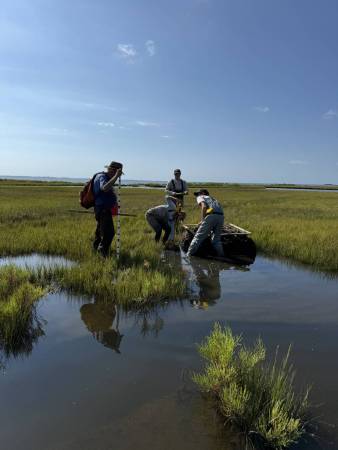
Another goal for these projects is to restore critical nesting habitat for target species like the Saltmarsh Sparrow. Maryland’s lower eastern shore has historically had some of the best habitat for Saltmarsh Sparrows and hosts about 25% of the species global breeding population. The Saltmarsh Sparrow is an endangered species that solely depends on high marsh habitat for nesting. As a result of decades of marsh degradation and loss, this species’ population has declined drastically. Although our partner organizations are focusing on the Saltmarsh Sparrow as a target species, this restoration will benefit dozens of other species and create a resilient ecosystem.
MCBP would like to thank the numerous partners who are helping us restore this critical habitat in our watershed. We would also like to recognize and thank the landowners who are granting us the permission to access their property to implement restoration projects and conduct important scientific monitoring. Finally, we would like to thank the state and federal agencies that have granted us the funding for these projects!