There certainly are ponies and nature trails and ghost crabs to catch, but one of the great parts of going to Assateague National Seashore is hitting the Barrier Island Visitor Center first. The visitor center is both a place for rest and relaxation (even when it isn’t open) as well as a place where you can get some context before or even during your trip to the island.
The horse-naming lottery allows people to make donations for the opportunity to name the new horses.
Targeted, engaging programing at Assateague
Assateague Island’s nature interpreters do everything from teach clamming and musseling classes, to leading guided nature trail hikes. These all are part of a bigger plan to make sure that the barrier island’s ecology and history are both understood and valued. The Visitor Center is kind of the heart of that whole program. It affords interpreters to give tours of the entire island without leaving the building, bringing people an up close and personal look at the native species and processes that keep the island one of the great destinations in the region.
Beyond the hands-on displays, the center also has a small theater that shows educational videos about the island and its history. Speaking of history:
Back when Assateague nearly was a resort community unto itself.
Plenty of history for exploring Assateague Island
Did you know Assateague once was being groomed as an Ocean City-style resort? Have you walked on whats left of the paved streets of that destroyed town? How about its history as a stop of for pirates, smugglers and all other sorts of romanticized half-villains from the colonial era through prohibition? The displays chronicling the island’s history provide depth that accompany’s the ecological displays’ breadth. In addition to the salvaged anchor from a Spanish ship and a few remaining street signs from the abandoned development, the visitors center provides information that can help people understand why this island has attracted visitors for more than 400 years.
People stop in all day for directions and information about the park as well as the local area. The National Park Ranger interpreters always are helpful.
People whose job it is to know
If you visit museums regularly while on vacation you know about rolling the docent dice. Sometimes the people who are providing you information are volunteers who are passionate but maybe a little less knowledgable than you might hope. In the visitors center the docents and other helpers are supported by Park Rangers, men and women paid and trained to be, if not experts, certainly highly knowledgable about both the island and the surrounding area.
They are qualified to give both directions and advice about local attractions and island activities as well as to advise on the rules for enjoying yourself at Assateague.
If you’ve never had the pleasure, there’s nothing quite like a conversation with Berlin artist Patrick Henry. Sitting in the quiet front room of his gallery one day, we talked art and business, aesthetics and politics, and the advantages of getting older. The topics weren’t that clean, they meandered into one another as they must when you’re talking about themes.
I’ve covered Patrick’s career, on and off, for the better part of the last 10 years, including what I take to be the two most important movements in his career: when his art was added to the permanent collection of the Reginald F. Lewis Museum in Baltimore and when he “found” his red paint. Both events were seminal to his work just after the turn of the century, when he began toying with changes in the distinctive style that had brought him regional acclaim.
Patrick’s family and teachers identified him as a natural talent at once and fostered and encouraged those gifts. This was astonishing in itself. Not a lot of young black men in segregation-era Worcester County were encouraged to pursue painting. Not a lot of men of any color were. This is the heyday of watermen and farmers. Labor from all racial sectors was prized above a pursuit of the arts.
Place became critical to Patrick, though, as he started his formal art education. Black artists of the 60s and 70s were particularly committed to depicting urban life. When I asked how common professional rural painters of color were in his generation, Patrick half laughed and then pretended he was going to count them off on his fingers. The era was dominated by people like Ernie Barnes (who did the “Good Times” painting) and the urban intellectual scene. Abstraction was the order of the day, even in representational art.
Patrick’s representational style set him apart from the first. His use of muted colors, and his emphasis on identifiable scenes from identifiable places on the Eastern Shore eventually made his work valuable enough that he was able to quit his day job and paint full time. That is what brought him to the attention of the Lewis museum and made his major exhibit, “Into the Light” a watershed.
He followed it with “Amusement” a show full of color and expression. He had been toying with color for a while, after painting a Barnes-esque reproduction for a friend. It was daring in that it didn’t look like a “Patrick Henry” show. But the paintings were from familiar Eastern Shore scenes, including those from the boardwalk past and present, and still identifiable. From “Amusement” he seemed to double down on rich color and made a series of paintings from the classic cars of Cruisin’ followed by black and white head shots of actors and actresses from the golden age of Hollywood. He punctuated these changes with continuing nods to his roots, producing the occasional landscape, but pushing them as well.
Patrick’s latest show at The Globe in Berlin features portraits of pop stars, his new direction asks a little more of the viewer’s participation.
It is nearly an oversimplification, but think of representational art as emotional. It asks the audience to bring their own experience to the act of viewing. Abstract focuses on the intellectual. The viewer is asked to tease meaning out of piece. Art, of course, is a spectrum, so let’s say Rockwell occupies one end of it and Mondrian the other. Between are artists working to find a balance between what they give to the viewer and what they ask of her. As Patrick begins to look toward the next phase of his career, he’ll probably nudge the needle a little further away from the representational.
The stories his paintings have told so far have been his stories, inspired by photographs he took or by places he visited. He only asked his audience to bring their memories of a place and a time to his work. From the landscapes, to the carousel horses, cars and celebrities, the viewer was just asked to feel one way or another about his work.
Going forward, he will ask more of the audience and, he hopes, deliver a new experience to them for their trouble. The work is of scenes, but not places. He’s thinking more about archetypes, using softer lines but more emphasized brush strokes. He invites the viewer to sharpen the lines, to interpret the stroke choices, but still in terms of their attachment to Eastern Shore-type scenes. That is, he increasingly is interested in painting scenes that have no place, no real address in the outside world. Patrick is less and less likely to work from photographs or memory, now, and more likely to work on intuition and will. First he wants you to think about the painting and then feel one way or another about your thoughts. He isn’t tempting you to remember where you’ve seen that place before. He tells you up front you haven’t.
As you get older and become successful you have to make a choice. It isn’t so much about cruising on a hard-earned reputation (although if you can and do, there’s no crime in it) as about understanding your ability to exercise choices. Patrick has cultivated a niche and an audience by delivering his vision and staying true to it. With each layer he has added to his work, he’s established himself as an artist who wants to encourage a conversation about the past and invite contemplation on its relationship to the present. This newest layer calls for viewers not just to identify how they see a scene, but why they choose to see it that way.
The recently-opened OC 360 restaurant on top of the Fenwick Inn exceeded the expectations of everyone in attendance one recent afternoon. The crowd was a mix of locals and visitors. Some had come to check the place out for the first time, others had wandered in just to see what was going on and several were hotel guests who chose to start the evening in the hotel before heading out. Nearly all the people at the bar were on vacation.
Jen White and Matt Reidy from Anne Arundel County were staying at a nearby condo and came to the Fenwick to have a beer or two before heading out to dinner with their family. The grandchildren were asleep and so the couple decided to make the most of their free time.
Jen has been coming to the Fenwick Inn for nearly three decades. She said she liked how the place looked and that she had many fond memories of vacationing in the area. For her it was a treat to be able to bring her grandkids in the same way she brought her kids to the Fenwick Inn when they were younger.
Jen White and Matt Reidy on the deck outside of OC 360.
The restaurant and bar features an outdoor area where people can dine or just walk out with their drinks and take in the entire length of Ocean City, both bay- and oceanside. It has always been one of the eatery’s greatest attractions.
Back inside Jacob Stampf and Morgan Murray, both from Pittsburgh were having a drink before they headed out for the evening. She was enjoying an Orange Crush and he a Duckpin Pale Ale. The restaurant’s full bar has everything from rail drinks and aluminum-bottled beers to premium brands like Bulleit Rye and an impressive selection of local, regional and national craft beers.
The pair weren’t regular Ocean City visitors, but each had been a few times and both were looking forward to their time at the Fenwick Inn.
Jacob Stampf and Morgan Murray at the bar.
Heather Grim and Beth Cross of the Westminster region were spending the evening at the Fenwick Inn before going to visit family in town and decided to take the opportunity to have dinner in the bar area. There was live music starting and the lady and her young charge sat at one of the tables overlooking Coastal Highway in the bar area. The had gone outside before hand to take in the view and decided to stay for dinner rather than look elsewhere.
They ordered as the music started and settled in to be entertained while they ate. Heather said she may eventually move to Ocean City and was looking forward to the trip. Beth has been a regular visitor to Ocean City for years.
Heather Grim and Beth Cross
As Happy Hour came into full swing more and more people filed into the restaurant and bar areas, which are separated but visible to one another. People who were interested in having a quieter dinner to themselves tended to choose to dine in the sit down restaurant, but the greatest number of people chose either a table in the bar area or a stool up at the bar. The staff was sufficient to the challenge as the number of diners grew and moved through the rooms and all were clearly happy to be there and honestly helpful.
The menu choices were diverse enough that there was something for everyone and, at happy hour prices, they also were affordable.
Over the last few days you may have noticed a sharp increase in the number of (and the excitement with which) people walking around looking at the world through their phones. They are playing Pokemon Go! an interactive video game that allows people to hunt for Pokemon creatures in real life. There are plenty of ways to use it for fun, but there also are many creative tactics for using Pokemon Go! for your business.
The game is not unlike a scavenger hunt in that there are items (virtual cartoon animals) to be found and collected. Using a phone’s GPS and its camera, players can see the virtual Pokemon world and get alerts that tell them where the nearest Pokemon creature is. Once they find a creature they have to capture it. There are various ways to do that but, for our purposes, just knowing that it must be done is a start.
The app is free to download and to use, although it does cause a significant battery drain places with charging stations and free WiFi, then, are particularly attractive to Pokemon Go! Enthusiasts. But that is not the only way businesses can take advantage of the opportunity provided by the Pokemon Go! Explosion.
Poke Stops and Poke Gym locations: There are many Poke Stops and Gyms in our area. The Town of Berlin’s municipal lot is a gym and there are at least five Poke stops nearby. Players use these stops to get tools for the game, from balls to incense and more. The original list of Poke Stops comes from Pokemon Go’s developers’ first game called “Ingress.” Regardless, many rural areas don’t have a lot of stops in the original game. Now, apparently, you can request that Poke stops be added. This means you can request that YOUR BUSINESS be added as a Poke Stop. This gets gamers to come to your business to collect important components for continued playing of the game. Comicbook.com gives instructions on how you can request a stop or you can go straight to the request form on PokemonGo.com’s website. In addition, Restaurant Weekprovides instruction about how businesses can lure Pokemon animals to their locations. As the phenomenon continues, there likely will be many more commercial options and applications local businesses can take advantage of in the coming weeks.
Even without purchasing “Pokemon Lures” as directed in the Restaurant Week article, businesses can get a handle on where they stand Pokemon-wise, simply by downloading the app and knowing which animals are nearest them, and whether and how valuable they are. Similarly, members of the management team can download the app to get a better sense of the attraction. This way they can make better-informed decisions about how and to what extent the Pokemon Go! app can add another dimension to their businesses.
The staff at the Chincoteague Bay Field Station, for example, took a very creative approach to show how neatly their mission dovetailed with the Pokemon Go! craze.
Pokémon GO has captivated a large audience, and not even Chincoteague Bay Field Station is immune. In case you’ve been living under a rock (or a Geodude), Pokémon GO is a virally popular mobile app that lets you catch Pokémon on your smart phone depending on where you are in the real world. Since the app debuted, you often can find CBFS educators and interns hanging around the Station’s sign out front, which is the nearest Poké-Stop to campus. And although we’re a little salty that the station wasn’t deemed a gym instead, we still love it.
The Pokémon you can catch are regional – Pokémon you’d get out in the marshes near Chincoteague are quite different than the ones you’d find in the more populated area around the Ocean City boardwalk. It just so happens that many Pokémon have real-life counterparts living in the same habitats. While you may not find a Ghastly floating around in real life, here are five Pokémon that bear a striking resemblance to organisms found on the Eastern Shore.
Squirtle is the iconic turtle of the Pokémon franchise, and the diamondback terrapin is the iconic turtle of the Eastern Shore. Both are cute, but can be a bit nasty if you’re not careful. Holding a terrapin may result in scratched hands from its claws. Holding a Squirtle may result in gallons of water being blasted into your face.
Both Tentacruel and the moon jelly can be found in the waters of the Chincoteague Bay. Moon jellies can get fairly big with a diameter of 10 to 12 inches. Tentacruel grow to be even bigger. Like Tentacruel, the moon jelly has many tentacles that can release toxin to catch prey. Unlike Tentacruel, a moon jelly will not knock over a skyscraper with said tentacle.
The osprey was clear inspiration for the Pidgey evolution line, especially the final evolution, Pidgeot. An osprey will use its keen eyesight to catch fish right out of the water mid-flight. Many of Pidgeot’s Pokédex entries also allude to its impeccable vision and ability to snatch prey out of the water. These Pokédex entries also say that Pidgeots can make gusts of wind strong enough to bend tall trees and that they can fly at speeds reaching Mach 2. Osprey can’t do either of those things.
While Krabby seems to be based on many different types of crabs, it matches the ghost crab the most out of the crustaceans on the Eastern Shore. Ghost crabs are famous for burying themselves in the sand on beaches. Krabby is famous for having what is arguably the least creative name for a Pokémon.
As the only type of seahorse we have in the area, the lined seahorse is the closest Eastern Shore equivalent to the Pokémon Horsea. Both creatures use their curled tails to hold on to grasses or other objects to either avoid being washed away by the current. However, the lined seahorse might actually be harder to find than its Pokémon counterpart, as camouflage is the poor swimmer’s first line of defense. In contrast, Horsea’s first line of defense is spraying bubbles at you.
Pokémon GO is a viral sensation, and for good reason. It’s fun, and it is great motivation to get outdoors. Next time you go on a Pokémon-related adventure, keep an eye out for the amazing real-life creatures that live on the Eastern Shore as well.
Chincoteague Bay Field Station, formerly known as Marine Science Consortium, is an environmental education center located on the Eastern Shore of Virginia. CBFS provides outstanding multi-disciplinary, educational and research opportunities that celebrate the rich natural, cultural, economic, and technological resources of the mid-Atlantic Coastal region through field-based and hands-on learning.
Over the last few weeks we’ve been working on a video feature called “Ocean City Stories” wherein contributor BL and I knock around Ocean City with a camera and a video camera and talk to people. You can see the completed work on our YouTube page. This week we decided to tackle fishing on the bridge, starting in West O.
It turned out to be a mediocre idea (which I can say because it is mine). It wasn’t that we didn’t get good folks to talk to. Actually, we got a few. It is because we parked by the side of the road and I am too old and fat to schlep over the Route 50 Bridge and back in my dress shoes and slacks. My face was a pretty fun-colored red by the end of it.
BL, who is the videographer/director of this video series is young and slim and enthusiastic. It is hard not to despise him as I’m humping along in the sun, but he’s charming and good natured and likely would be missed by his family. I picked him up at the Ocean City Park and Ride and drove to the foot of the bridge. It’s hard to give you a sense of how little space you have out there when you stand between your parked car and the Ocean City bound Route 50 traffic.
Boaters headed out for the evening after dining at Sneaky Pete’s. People are always up for a good time when boating in Ocean City.
Biking across the Route 50 Bridge
My hope was, at first, to catch some commuters, those people you see riding their bikes across the bridge after a long shift downtown. The bulk of the bridge bike (and, really, foot) traffic is comprised of people who either live in West O or Ocean Pines or people for whom the West Ocean City convenience stores and groceries are more convenient than those farther uptown. Suffice it to say that none of them were really interested in talking. Most were interested in getting home and showering, I assumed.
After more than a decade as a reporter you can smell the, “Don’t talk to me” that emanates from some people. There was no need to go all Chris Hansen on them for some friendly Ocean City stories, so we let some pass without making our pitch. Others (I assume those who were heading across the bridge to shop rather than to shower and turn in for the night) had a more approachable demeanor, but turned us down flat.
Editor’s note: If you are a bike commuter, reach out. We’d love to chat with you.
Ever the cinematographer, BL noticed a school of rays cruising along in the shallows and I got off a couple of quick, poorly framed photos. As I was taking them I knew they were bad. That’s the level of photographer I’ve risen to. I can tell when I’m doing acceptable work and when I’m not. Hopefully I’m wrong. I haven’t edited the photos yet, so I don’t know. If the following is a photo of a school of rays (or skates, or whatever) then I was able to salvage it.
Skates (or rays) in the Assawoman Bay cruising the bridge.
Route 50 Bridge work
We moved on to the SHA guys who were standing over what, it turned out, was a hole in the bridge sidewalk. It was a stress fracture, or something of that nature, that they had patched. There was no danger to the cars or the structure, but if you were cruising across that bridge on your bike at night you were in for a nasty bump at the least.
I don’t know how often you have the opportunity to try and have impromptu interviews with SHA workers on the job, but let’s just say they weren’t particularly chatty. BL and I had come the the conclusion we were on the wrong side of the bridge. There were people coming and going on the other side. We elected to cross.
If you didn’t know, there is a gateway in the bridge pedestrian walk that allows someone to cross from one side of the bridge to the other. There is a particular horror in trying to use the crosswalk in that, you can’t see around the fence from close up. Your choices are to step back and look both ways or to stick your head out into the road and look both ways. I started by peeking around the corner, super-spy style, until I was comfortable with the generous distance between even the farthest-right diving bridge patrons.
“So, we’re really going to Frogger it?” BL asked, trying not to sound too enthusiastic at the prospect.
What I wanted to say was that I surely was a Frogger champion long before he was born. I have placed a quarter on the “next up” line for Frogger in a video arcade. Of course we would Frogger it.
What I did say was, “Yes.”
This gentleman is a fisherman on the bridge one week every year.
Getting ready to run is so much more difficult than actually running. It is a choice to commit and to live with your choice and to place your faith as much in your own abilities as in the abilities of drivers to break on the outside chance you were wrong.
I really enjoy doing things that are dangerous for 45-year-old vaguely out of shape white guys. I engage in occasional minor crimes when I’m sure I can get away with them and (and this is the worst, more cliche of all the things) pretending that I’m on par chance-taking-wise with 20 year olds.
We hit the far sidewalk with ease. I wasn’t certain BL even considered it an effort until we crossed back later and he admitted he hadn’t sprinted with his camera gear over his shoulder since high school.
The rest of the afternoon went as expected. We found a couple of people to talk, we struggled with the audio against the racing cars on the bridge, we Froggered back to my car. I stopped at the Royal Farms on the way home, purchased a gallon of water and drank half of it on my way back home.
It’s been two years since Budget Travel named Berlin the Coolest Small Town in America, but that doesn’t mean the town has lost its charm. In fact, Berlin now is cooler than ever (and I’m speaking to you as an expert on all things cool).
In 2014 Berlin’s residents, with their undying small town pride, nominated the city and helped it reach 28 percent of the vote among 14 fellow cool-town finalists. Budget Travel commends Berlin for its proximity to Ocean City and Assateague, and for famously providing the backdrops to Runaway Bride and Tuck Everlasting—statements that alone would provide sturdy support for any coolest small town nominee, but that aren’t even close to being the only reasons why Berlin is so special.
Berlin has more than earned its placement in the catalog of cool towns. Here are 5 reasons why this small town is still the coolest.
Stephen Decatur Park view
Berlin is surrounded by all the wonders of nature
Berlin is a green town both visually, framed by trees and sprawling foliage, and environmentally: the Grow Berlin Green campaign, which began in 2009, seeks environmental protection, conservation and smart growth practice for the community. GBG works wonders in its parks and playgrounds, which remain beautiful and clean year-long, and in ways that we can’t always see. Recycling, stormwater and wastewater management and, among many other initiatives. Increased activism among Berlin citizens and policymakers provides the support to keep the community green and friendly towards the Earth.
The three parks in the area, Stephen Decatur, Dr. William Henry and John Howard Burbage provide fun for children and atmosphere for adults, and there’s never a lack of places to hike, picnic and enjoy the natural surroundings.
There’s no shortage of cute, unique and slightly weird shops
Berlin is a hub for independent retailers and antique stores, where you can always find a somewhat off-kilter souvenir to bring home. It’s unlikely that most towns in 2016 can boast the presence of a video rental store the way Berlin can, and the prevalence of retail stores and wine bars makes for a great combo—one store even invites you to shop while you drink.
Berlin is heralded as the antique capital of the Eastern Shore—Culver’s, Stuart’s, Uptown and Town Center Antiques are all present on Main Street, and I can never simply walk past Toy Town Antiques—the Blues Brothers beckon me from the store window to come inside and sort through Barbies, Beanie Babies, and shelves upon shelves of tiny kitsch Santas. Very cool.
There’s almost always something to do
If you somehow grow tired of the shops, art galleries and restaurants, there’s almost always an upcoming event to bring you back into town. In the summer, local businesses turn bathtubs into “racetubs” at the Berlin Bathtub Races, and the Berlin Heritage Foundation sponsors the annual Peach Festival. Concerts on the Lawn are a frequent happening, along with the 2nd Friday Art Stroll, and nothing welcomes in the fall like Octoberfest with its sidewalk sales, beer garden and Corn hole tournament.
It’s got a rich and colorful history
Fun fact: the town’s name most likely came from an old Tavern, as “Berlin” is thought to have come from a combination of the words “Burleigh” and “Inn.” (Editor’s note: With due respect to the memory of Ed Hammond, we endorse Burleigh). Even before that, the path of Main Street was once walked by the Native Americans of Assateague and Pocomoke, and later became the Philadelphia Post Road that connected the north and west centers of commerce.
Stephen Decatur, the 19th century naval hero and namesake to the nearby park, high school and roads, was born in Berlin. While Decatur’s birthplace is unfortunately no longer standing, downtown Berlin is a National Register Historic District whose older buildings include Burley manor, the Chandler house and St. Paul’s Episcopal Church.
It’s probably haunted
Of course, most of the old places that contribute to the color of Berlin are supposedly totally haunted. A secret society known as the Independent Order of Odd Fellows, originating in Baltimore in 1819, once held shop in the heart of Berlin. Their duty was “to visit the sick, relieve the distressed, bury the dead, and educate the orphan,” and they also partook in a number of mysterious rituals—one of which has resulted in human remains being found within the walls in many of the Fellows’ former lodges. Their former lodge in Berlin is now a yarn shop, but the letters IOOF still are etched proudly on the outside of the building.
Also, the landmark that is the Atlantic Hotel is notoriously haunted and is associated with at least five different ghost stories. Berlin’s Ghost Walk (one of many Chesapeake Ghost Tours) features the hotel and several other locations that are rumored hotspots of paranormal activity: the former Odd Fellows Hall, the Maryland Wine Bar, the Pitts House, St. Paul’s Graveyard, the old Dairy Queen and the Calvin B. Taylor Bank, where a woman in a long white dress is frequently seen standing near and where a soldier still in uniform walks nightly.
What could possibly be cooler than a haunted, historic town that hosts races in bathtubs and actually cares about the environment? There may be a few odd fellows in Berlin, but at least they have plenty of small town pride.
There is a sensory experience that is as much taste as it is smell when you pass from the oppressive heat of the parking lot and into a well air-conditioned partially darkened bar. When I rolled up to The Ropewalk (honestly just trying to get a little work out of the way before I went home and not intending to have a Happy Hour Adventure) I saw that already it was Happy Hour, which did its job by making me happy.
An early happy hour in the summertime just makes sense. For most vacationers, happy hour lasts until you start packing to go home. The thing about The Ropewalk though is that while it is not a “drinkers” bar, it still is a bar for drinkers. The difference being that it also is a family place, and there were equal parts from practically every generation present when I stepped out of the heat and into the freshly cooled Ropewalk lobby.
At first I thought there were an awful lot of staff members walking around. It was a little after 2 p.m. or so and there weren’t a ton of people present. Later I would discover that these folks were preparing for the evening rush which was just about to start and would continue well into the evening. There are few things more frustrating than having a wonderful time in an understaffed restaurant. Having to search for a server detracts from your experience because it puts the focus on the fun you aren’t having rather than the fun you are having. There is no way this happens at The Ropewalk. Staff members were buzzing in groups of twos and threes getting ready making sure there was silverware making sure there were glasses making sure that the glasses of the people that were there were full, but not being oppressive about it.
Noah and Mya Howard and Olivia Walter were happy to run off into the play area while Maura Howard and Randy Walker ordered dinner for the group.
A note on family friendliness
One thing that it is easy to forget about when you go to a destination bar is how professional the bartenders are and also how much fun they have. Just to be clear, a destination bar is a place that you go to to settle in for a while. What makes The Ropewalk a destination bar is that it has multiple bars for multiple sensibilities. It has games for grown-ups and children, it has a water view and it has a restaurant. If money is no object you literally can show up at 2 p.m. and pour yourself into a cab at 2 a.m. and have had an absolute blast. I don’t necessarily recommend this.
As part of the Happy Hour Adventure series mostly what I will write here is about why it’s fun to go to happy hour at a particular place. That is not to take in any way away from how family-friendly The Ropewalk is. There are distractions for the kids there are games for the kids there are fun drinks for the kids and there are menus for the kids. As I looked around at some of the young families I saw The Ropewalk as the perfect opportunity to have a date night with your spouse as well as a family night out. It turned out to be the same thing. The playground is safe and easily viewed from the right table in one of the sandy beach bars so you can take some time to reacquaint yourself with your spouse and every now and again look over your shoulder and tell little johnny to stop jumping off the apparatus. Seriously, though, you can have a fun time there with your family without forgetting that you are a fun loving person as well.
Liz Williams and Sean Duckworth play corn hole and enjoy their drinks in the sun.
Afternoon party time
I made my way to the back bar there were two bartenders there and they were looking a little lonely. Mostly they were as the rest of the staff was setting up for the evening, but they were joking and talking with members of the band who are also getting ready for a big night and generally having a good time. Having a good time is critical if you’re a bartender in Ocean City in July. It is going to get busy and you want to remember that only can be projected if you are actually having fun. I have yet to meet a camera shy bartender and the two guys in the back at The Ropewalk were no different. One was making an orange crush the other was pulling a tap beer, and both were making a real effort to make sure they each got a chance to show off.
The beer selection was fine and there were a number of local beers available which is something that’s important to me. The orange crush was orange crush-y which is really the most you can ask from and Ocean City bar.
Across a distance of tables there were two other bartenders at a different bar also prepping and goofing around. I have it written before about the preparation period, but it really is something worth watching (and a great excuse to show up at a bar at 2:30 in the afternoon).
Bartender Shannon Fitzgerald was both chatting with me and the customer and the other bartender she flitted from tap to glass to customer. The one thing that at a good bartender knows is how important preparation is. It won’t do to run out of orange crush at 8 o’clock on a Thursday night. You have to be prepared. People are counting on you. Everyone is having their best night out all the time, potentially, and the bartenders know that. I think that’s where the fun time attitude originates.
As I made my way out to the parking lot a line was beginning to form already. There were plenty of seats still and people weren’t waiting for tables, but the front desk only could accommodate so many people at a time.
Most were families with kids, many of whom were interested in sitting either out on the deck with a view of the bay or in the sand with a view of the playground. All would get what they wanted in time and once they were seated would be served promptly by the waves and waves of staff members that continued to appear seemingly out of nowhere folding and carrying and pouring and hustling.
It was a sight to behold. It is a site worth beholding.
One thing about Ocean City that surely is unique are the friends you can make and the people you meet when you live here, and with today’s technology and social media, keeping in contact with past coworkers, old friends, or even temporary acquaintances is so much easier. It also can be less awkward. It is acceptable to become best friends on snapchat with someone you’ve barely spoken to, and you’ve met in person maybe a few times. Then there’s the fact that the people you can meet who become your friends in Ocean City may be on the other side of the state, country, or world.
During the summer in Ocean City, there are a lot of students traveling abroad representing countries around the world. They come to Ocean City to work, to travel and to see the United States. I have met people from Russia, Croatia, Ukraine, Romania, Ireland, Germany, Czech Republic, Hungary, Canada, Mexico, Chile, Brazil, India, China and South Korea. Then there are tourists that come for a few days in the summer to relax on the beach. I’ve seen license plates from almost every state in this country. It does not matter the distance, California, Florida, Washington, Nevada. Ocean City seems to be the place to be in the summer.
The people who live here are exceptionally friendly. I never had noticed or thought about it before it was pointed out to me, but we are. Even in the summer, I had been saying why I enjoyed Greece so much to a friend at work who is from Romania; I mentioned that everyone there was friendly and would actually talk to you, and she agreed that that was one of the reasons why she liked it here so much. We smile and ask about each other’s day, whether we’re acquainted or not. I’ve gone to Baltimore and asked cashiers how they were and they would look at me shocked. In Paris, New York, Rome, people glare and pretend not to notice you. To live here and have the friends you can make here is truly exceptional.
That is the reason why I am glad to call Ocean City home; why I am grateful to have the friends I have and live in a time where the technology is available to me so I can keep in touch with them, regardless of where we go in life, even if it is back home.
Looking for a few days away from the hustle and bustle of Ocean City? Not far from the ocean, on the other side of the Delmarva Peninsula, lies the Chesapeake Bay. And dotted across the eastern shore are a number of beaches and state parks to light the fancy of any soul willing to take the trip just a little east. Private campsites abound from Delaware’s beaches to the shores of Assawoman Bay, the Isle of Wight Bay, and down into Chincoteague Bay in Virginia. But this is summer, and unless one has planned far enough in advance, getting a camping spot that faces the Atlantic Ocean is near impossible. Look a little further and you might find a little state park just outside of Crisfield, Maryland that is right up your alley. Janes Island State Park is a great weekend getaway on the shores of Tangier Bay which bubbles right into the vast waters of the Chesapeake Bay.
My family arrived on Friday night and plugged in our little camper. The setting sun, falling over Janes Island to the west, is the highlight of this hidden little gem. From the long stretch of campsites that front Daugherty Creek Canal almost every visitor gets a beautiful view of the yellow sun as it fades into the water’s edge.
The land near Janes Island was first inhabited by the Annemessex indians. When the English settled in the area they found the Annemessex indians to be a friendly people, and they began to farm the marshy island itself. The fertile soil proved bountiful for growing watermelon, cantaloupe, apples, and peaches. Nearby waters were plentiful, too, for oysters and other fishing. Farming on a marsh, however, proved difficult, and by the 1930s most of the farm land had been abandoned. The only visible man-made structure on the island is the tall brick smokestack left over from a fish processing plant on the southern tip that was destroyed by fire in 1932.
On Saturday we rented a canoe from the park and, with lunch packed, rowed across the Daugherty Creek Canal, dredged in 1939, and into the miles of channels that wind through the island itself. Even for inexperienced canoers like us the water was easy to navigate, and in less than an hour we were on part of the miles of beaches on the bay side of the island accessible only by boat. The water in Tangier Sound was warm and calm, a far cry from the cold and sometimes raging waters of the Atlantic Ocean. The area is a big draw for fishermen who love to ply the waters around Janes Island where the striped bass are as long as a grown man’s leg and fight hard to stay in the water.
Our first night there we saw a boat coming in with two men on board. My daughter was fascinated by the boat, and she watched the men pull the boat into the dock. “What are they doing now?” she kept asking. It was a shallow green camoflouged skiff with a flat floor and two main seats, one behind the wheel and another in front of the wheel. Benches lined either side of the prow, and there were half a dozen fishing poles of various lengths and girths. While the captain of the ship backed his boat trailer into the water his companion showed us the fish he had caught, about two-and-a-half feet long. “The others were bigger,” he told us. “This was the only one we managed to get into the boat.”
While there seemed to be a lot of boaters going out into the water, most of the vessels we saw were canoes and kayaks loaded down with up to four people. Like us they seemed to be newbies to the boating scene. I saw one couple in a kayak doggedly rowing their small craft into the dock. The husband in back rowed forward while yelling at the wife to steer, while the wife rowed backwards and yelled at the husband to steer. (Like most arguments between husbands and wives, the wife was right—it is the aft passenger’s job to steer the boat.)
What impressed me most about Janes Island State Park was the nature center attached to their camp store, and the number of activities they had planned for kids. We brought a car full of games to play and balls to toss around with the kid, but when we returned from our boating excursion shortly after lunch she discovered a room full of kids all making crafts. She returned to the campsite carrying a can with holes in the bottom that she said was for putting out our fire. Then she took me back to show me the marshmallow roasting stick she’d painted. Later, just after dinner, more than a dozen kids from the campground gathered around a small firepit behind the nature center while a visiting musician played a guitar and one of the park rangers led them in campfire songs. My daughter was front and center for the singing and the dancing.
In the evening, as the sun again settled over the water, we sat beside our camper in the shade of a tall loblolly pine and read. The air was cool, and though the greenheads were all around they weren’t as bad as they had been when we were out on the water. At home my mind would race with all that needed to get done: a weed-filled yard, an unfinshed rain garden, a lawn that needs mowing, a house that needs cleaning, a desk that needs building, and a roof that needs fixing. Here, though, I relaxed, disconnected, and enjoyed the warm evening, the smell of the fire, the water lapping at the marina. Janes Island State Park is a perfect place to get away to recharge your spirit. And it’s only about an hour’s drive from Ocean City!
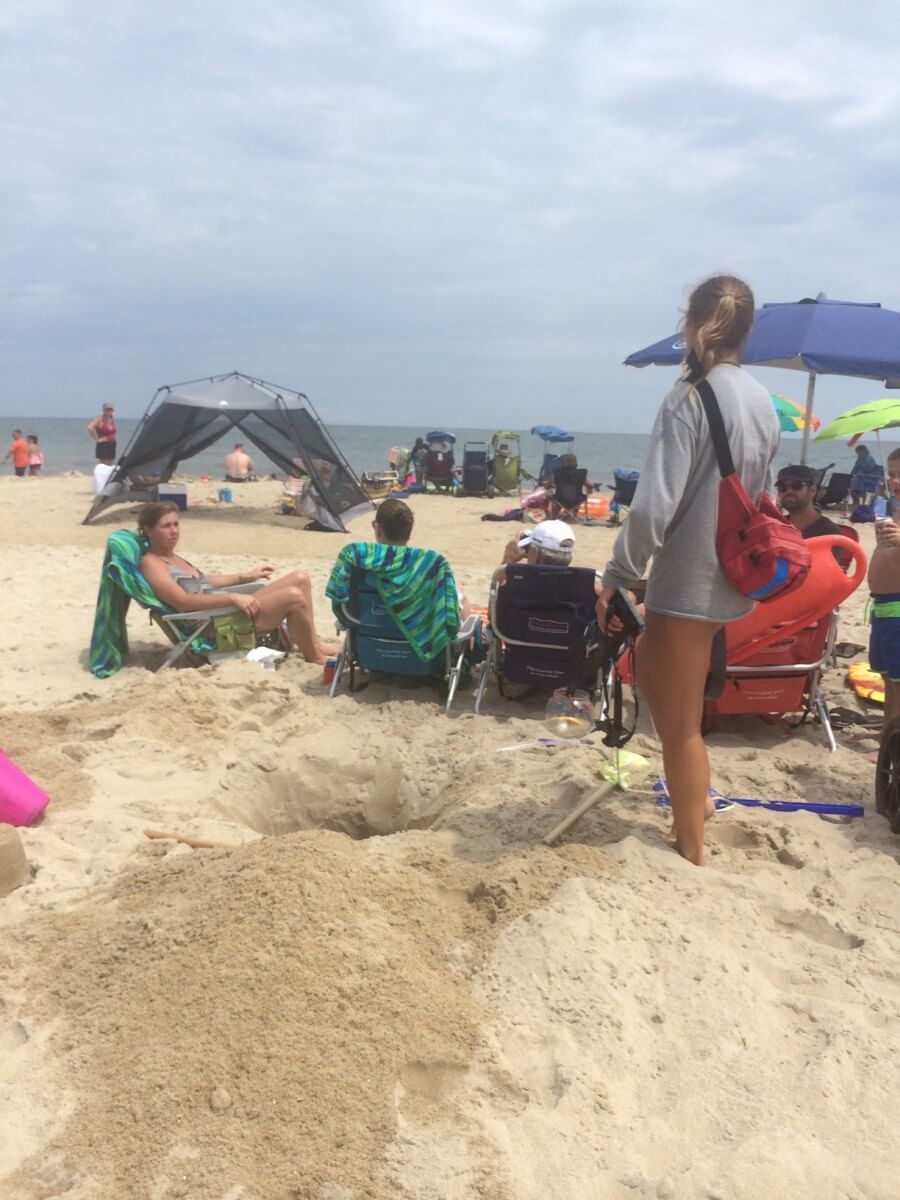
Whenever you go to the beach you are sure to see people of all ages digging in the sand. Digging a hole is normally viewed as a chore however at the beach it suddenly becomes a fun way to pass the time. I have come to realize that most people have no idea about how dangerous digging deep holes in the sand can be. Lifeguards know that these holes—even fairly shallow ones—can collapse and kill. They monitor digging holes and will inform diggers that the sand can be a serious hazard. Lots of people dig holes or tunnels in the sand, but they don’t know their holes can quickly cave in and trap those inside. The rule is simple and straightforward: you can dig holes on the beach as long as they only take up a small area and are no deeper than the knees of the smallest person in the group. There is absolutely no tunneling allowed. Never leave your hole unattended and always fill it back in so it isn’t a hazard to others.
Seven summers ago in Ocean City, an 11-year-old boy attempted to dig a tunnel between two holes. The tunnel collapsed and he was buried alive, headfirst, with only his feet exposed. There was nothing he could do to save himself. The more he struggled the tighter packed the sand around him became. Lucky for him a girl noticed the trouble and alerted a family member who began efforts to free the child from the sand that not only was trapping him but also taking his life. As several minutes passed, the situation became frenzied when the mom screamed for help.
The scream of terror brought several nearby beach patrons to assist with unearthing the trapped child, however, these efforts were making little progress and in actuality were making the situation worse, which is usually the case with a bystander response. As the first lifeguards arrived on the scene they immediately went to work and with a more organized effort were able to recover the lifeless body of the boy. This is a skill that surf rescue technicians (SRTs) are trained in and practice each season for emergencies such as these. They performed CPR and this story had a happy ending. In fact we still keep in touch with the family who remains forever grateful.
For some hole diggers, the story can have a deadly ending. We try to tell people about the dangers of digging holes in the sand before their, often-intricate, pit digging plans get too far underway. There is something about a day at the beach that makes people want to dig and most people don’t realize the dangers. Digging a shallow hole to lie down in and get covered up for a picture is funny and safe. But anything deeper than the knee is not. Out on the beach digging holes has become just another part of the vacation like looking for sand crabs or eating fries on the boardwalk. Our SRTs always do their best to monitor the different situations on their beaches, but on a day when the water is busy and the beach is crowded with umbrellas, diggers can make dangerous amounts of progress in the sand, not even realizing the potential for danger, before they are asked to fill in their holes.
Facts about the dangers of digging deep holes in the sand
SRTs are often asked by hole diggers why deep holes are not allowed. Let us review the facts. Deep holes are dangerous just about anywhere they are found and people usually try to avoid falling into them. Sand holes are particularly dangerous because they can collapse on the people digging them. Also, the vacation-oriented mindset of hole diggers clouds judgment, and people tend to underestimate the possible dangers of jumping in and out of a giant sandpit. Many times people want to get their picture taken in the hole that they dug not realizing that at any given moment the sand can cave in around them. Once a person is buried in the sand it is very difficult (boarding upon nearly impossible) to dig them out and have a positive outcome.
Sand shifts back into place even as people try to move the sand off of a trapped victim. Interviewing several people who attempted to help the 11-year-old boy referred to in the above Ocean City emergency confirmed that this was exactly what was happening to them. As they feverishly attempted to remove the sand that was trapping the boy, more sand just as quickly took its place. One might be amazed that it would take 40 people 30 minutes to free a buried victim. Just as a person can drown in a small amount of water it does not take a very deep hole to trap a child and once trapped due to the nature and instability of sand holes a person could parish before being freed Hence the rule that the hole may only be as deep as the knee of the smallest person in the group of people digging the hole.
The danger is real
I have heard some people say that people being buried alive under the sand is an old wives tale that lifeguards use to scare people into obeying a rule.Let’s look at the startling statistics.
More than several dozen young people have been killed over the last decade on beaches in the United States when their hole or sand tunnel collapsed on them.
Harvard researcher, Bradley Maron, who has been tracking sand hole collapses worldwide for the past decade says that 60 percent have been fatal.
When you look at sand hole collapses worldwide the number dramatically increases and if you look at entrapments that do not end in the death of the trapped individual, the statistics would report hundreds each year.
Interestingly, people always ask about sharks, which never have been a problem in Ocean City. However, national statistics comparing sand hole collapses to shark attacks confirms that you are far more likely to experience a sand hole collapse than a shark attack. A person has a 1 in 3,748,067 chance of a shark attack fatality. So instead of asking every lifeguard how many shark attacks there were this year, people should ask, how many sand hole collapses occurred.
It seems unbelievable that a vacation could end so tragically, but it does happen. Use common sense and keep your hole digging to a safe depth. Remember, if you do dig a hole, never leave it unattended and make sure that you fill it in before you leave for the day.
A gentle reminder
As our dunes are recovering from this past winter’s storm and trying to become more substantial, the dune grasses are flourishing. We are finding that children are being drawn to play in the dunes and dig. Although this has never been allowed we want to urge parents and beach patrons to stay off the dunes to allow them to grow and continue to protect our beach.
The Ocean City beach has one of the cleanest, finest sand you will find anywhere. Enjoy it, but please do so in a safe manner. One thing that you can always do to remain safe is limit beach activity to a time when lifeguards are on duty. Remember to always keep your feet in the sand until the lifeguard’s in the stand; it could safe a life, yours!
Many of the big hotels offer sweeping views of the ocean and bay. Striking hotel views are something many of us have come to expect from a stay in Ocean City. But besides being able to see for miles, there are hotels that are ideally placed to get a different view of Ocean City. Alternative views that are particular to the place and maybe show something a little different if no less stunning.
Catty-corner views at The Grand
The Grand long has been known for its spectacular oceanfront experience as well as its distinctive look. The hotel’s pool deck looks out onto the strip and anticipates the sunset, while providing walk-on beach access from the Boardwalk exit. These two photos were taken from the 28th Street exit and the Grand Hotel parking garage, so from the bottom left and top right, respectively.
Boardwalk level in front of the Grand Hotel. Sometimes the ground-level shots get you perspective you might otherwise have missed.
People enjoying a bright day at the Grand Hotel pool. As sunset approaches, it’s a great place to enjoy the coming on of evening.
Crossing State Lines
Heading uptown, the newly-opened OC 360 at the top of the Fenwick Inn provides the kinds of views pretty particular to a rooftop bar and restaurant. On the one hand, you can sit inside and enjoy the sites while having your dinner or hanging around at the bar. Alternatively, you can slip out onto the roof deck and enjoy the sun during the day and the sunsets in the evening.
From your seat at the bar atop the Fenwick Inn you can watch the uptown scene in complete comfort while people bring you food and drinks, pretty sweet.Jen White and Matt Reidy on the deck outside of OC 360 on top of the Fenwick Inn. During the day there is plenty of sun but as the evening comes on you can watch it set while enjoying an evening cocktail or even a meal.
Rethinking grandeur at the Holiday Inn and Suites
Setting aside the multiple deck-pools indoors and out and the astounding views from the rooms, the Holiday Inn and Suites has one of the most astonishing beachfront facades mostly because of its sweeping staircase. Running from the boardwalk to the hotel’s entrance, the staircase has a vaguely hourglass shape that has framed thousands of vacation photos over the years. In fact, it is so easy to get distracted by the beach views that you may forget to appreciate some of the other views the place has to offer.
Coming up the sweeping staircase of the Holiday Inn and Suites it’s easy to forget to look up and get the full measure of how impressive a place it really is.The bayside view from the Holiday Inn and Suites is absolutely serene and too often overlooked in taking in the town’s vistas.
A sublime afternoon at the Dunes
Even at the height of summer it is easy to feel a pleasant solicitude at the Dunes Manor. Even among other people who are enjoying the view from the storied deck just above the beach you feel as if you have the place all to yourself. But another underrated alternative view is from the beach on the way back to the hotel. Seeing the people relaxing and the solid, stately oceanfront facade of the Dunes gives you a better appreciation for staying inside as well as hanging around outside.
The view from the deck at the Dunes is like no other because it is often from a solid rocking chair with a cold drink in your hand.After a long day of relaxing on the beach, it is nice to know you can come back up the sand to the Dunes and get right back to relaxing under the cover of the deck with a drink in hand.
Hiding Out at the Clarion
As a resort hotel it isn’t shocking that the Clarion Fontainebleau is designed in a way that you only have to go out if you want to. What’s fascinating, though, is that its nearly imposing front hides a veritable paradise. In addition to providing grand views both up and down the beach, the outside bar provides a paradoxical combination of privacy and public profile.
Coming out of the back deck on your way down to the outside bar provides one of the more peaceful views in Ocean City.Once the sun passes over the hotel at midday, you can spend the afternoon and evening just lounging in the shade between dips in the ocean.
Chincoteague Bay Field Station (CBFS) is pleased to announce that it has received a $91,000 grant from the Environmental Protection Agency’s Local Environmental Education initiative. These funds will support on-going work at CBFS’s Living Shoreline site in Greenbackville, VA which models best practices for coastal resiliency. The award will allow CBFS to provide free field-based programming for 800 local students on Virginia and Maryland’s Eastern Shore between 2016 and 2018. Additionally, it will support CBFS’s Shore People Advancing Readiness for Knowledge (SPARK) program and other community-based events. Through this, CBFS will offer sub-grants for local organizations to carry out similar restoration projects on sites across the peninsula. The RFP for sub-grants is now available on their website.
“This award will allow our organization to take environmental education to the next level in our very own community. With this funding we will be able to provide free programs to our local schools that, otherwise, do not have the funds to engage in a three-day program,” says Executive Director, Amber Parker. The field experiences have an emphasis on local and regional environmental issues. “We recognize the Shore’s vulnerability to flooding, erosion, and extreme storm events. These programs will explain some of the issues at hand and offer best-practices for creating resilient coastal communities in the face of a changing climate” says Parker. CBFS is currently accepting reservations from teachers and schools on the Eastern Shore of Virginia and Maryland to reserve spaces for free field trips on a first-come, first-served basis. Teachers and administrators may contact Parker McMullen Bushman for more information parker@cbfieldstation.org.
I graduated high school in June and the week that followed graduation was filled with questions like, “Where am I staying this weekend?” Or “What trouble I was going to cause during senior week?”
I had always figured I’d work during senior week, just as I had the years before. And besides, I did not want to be associated with Senior Week and the negative connotations that came with it.
Senior Week to the locals is dreaded. A lot of Ocean City is geared toward Family Fun, including no smoking or foul language on the boardwalk. But the two weeks following high school and college graduations the whole scene changes. There are drugs, alcohol abuse, blatant recklessness, and even some deaths. But how dangerous Ocean City is in June cannot be blamed solely on the seniors that come to celebrate graduation, there are a lot of factors that play into the danger of that particular month.
Nine of the twelve months of the year Ocean City has the population of a rural community. May of the hotels and restaurants close for the season, and all the Boardwalk rides are closed November through March. If you stand out on the beach all that can be heard are the waves and the seagulls. The Boardwalk is empty; Ocean City looks like a ghost town. June is the first month where Ocean City has crowds of people every day and businesses, the police department and the locals have to adapt. June is a sudden shift from having hundreds of people in town, to thousands.
Crime cannot be covered as easily, people get away with minor offenses sometimes. And it can be anybody, though seniors are the usual culprit for that kind of thing, because we have followed the rules and been relatively good students for twelve years and see senior week as our opportunity to be free. So during June right after graduation we can be reckless and do stupid things and throw parties into the early morning.
That comes to the next reason why Ocean City can be dangerous in June. There isn’t a late night high school or senior party out there where no one has brought drugs. As new adults or even still as students we are a great target for drugs. We need to stay up late for studying, we need to be energetic and alive in class, we need stress relievers and ways to ignore the world and shut it all out and that is what drugs do. They make us look cool and dangerous, or make it easier to lighten up and have fun, but not all drug dealers are nice people, not all play by rules or sell what they’re advertising. And whenOcean City is full of seniors in June, it is also full of people there just to sell drugs to us. They are the ones that can cause the most deaths, if it’s from fights, or over doses.
The danger of June is not just senior’s fault, it is the fault of anyone making rash decisions during a time where safety cannot be kept up on as easily, and by July people can keep up easier, but until then be safe.
Like a lot of you out there reading this article right now, I’ve been vacationing in Ocean City since my childhood, and it’s fair to say that tradition with a side of nostalgia is what keeps me returning year after year. But one of the things I like most about this resort is that we always find something different to do while we’re visiting our little beach town. We have our favorite places to go and things to do, but I believe it always is important to try and incorporate new things into the itinerary to avoid having your trip end up with that “been there done that” kinda feel. As my wife often says to me, “Every year is a different vacation”.
This year our attempt to keep it fresh lead us straight to a mental hospital… inside one of the city’s newest attractions: Ocean City Screams. Now. don’t worry. I’m not going to ruin the fun for you by going into detail on the horrors that await for you inside this multi-level haunted house. You’ll have to muster up the courage and go explore this spooky lair without any spoilers from me, and I’d suggest you not to search the web for any either. After all, the element of surprise is critical when getting the most out this kind of experience. This is one of those cases where the less you know the better.
Stuff I can tell you
You need to know this is not a ride, this is a walk through house with multiple stairs, moving floors, and of course some very dark rooms. Like most haunted houses that typically make the scene around Halloween time. it is geared toward the younger generation. My son was more than eager to go, while I on the other hand played the quintessential dad role and just went along almost grudgingly. But meanwhile there was a small part of me that secretly was anticipating it just as much as he, perhaps even more. When I was a kid my father would go on the Haunted House ride at Trimpers with me every year without fail, but he flat out refused to take me into Morbid Manor. The original Morbid Manor was a walk through haunted house. That’s all I can tell you because I never have seen the inside of it. I assume my father thought it was simply too scary for me, so in a way this trip through Ocean City Screams was around 40 years in the making for me.
We did take our 12-year-old through it and he absolutely loved it, but it’s not recommended for children under 12. I can tell you as we were walking up toward the entrance we witnessed two girls about 14 years old walking down the sidewalk in tears as they exited the attraction.
Now, I personally didn’t see anything scary enough to cause this type of reaction, but the good news is if you do find yourself too scared to press forward you can always exit the house simply by walking through any number of the bright red curtains, located through out the house. I highly recommend walking through the black curtains, which is the path for those brave souls who wish to see the house from start to finish, but make sure you take your time upon entering each room, as there are motion activated and time sensitive features that will lose some of their effectiveness if you rush through.
The props and effects are amazingly realistic, the actors take their roles very seriously, and I can only imagine how much work goes into some of their make up. While the ghoulish characters inside do their best to drive fear into the hearts of those who choose to enter, outside the management is welcoming and professional. This should come as no surprise considering Ocean City Screams is part of Steelhead Events and Productions. The company has been recognized as being the Best Haunt Designer and Builder in the United States by A&E Network and have 2 other haunted houses in MD & DC. There really is no substitute for experience, and is the reason why their roll out went so smoothly. They have systems in place, and they already know what works. They take the time to explain the procedures to each group before they enter, and survey them as they exit.
Don’t pass it by
If this place has one draw back it has to be the location. It sits on Worcester Street, but you can’t see it from the boardwalk. This might be a pretty big problem for them to circumvent, because unless you read about it online, you could walk right past this street from the boards ’till the crack of doom and never know it even is there. We were looking for it and couldn’t see it until we were practically right on top of it… I asked the manger about it, and as of this writing, he was keeping his fingers crossed for the town to allow him to advertise by putting a sign on the boards. If the sign is still not up by the time you’re ready to give this place a try, just remember to step off the boards between Marty’s Playland, and Sportsland and follow the walk up to the corner.
Annapolis Bluegrass Coalition will perform at the Berlin Heritage Foundation’s second concert on the lawn this season on Sunday, July 10th at 6:00 p.m.
Bring a chair and a picnic to enjoy this free concert on the lawn of the Calvin B. Taylor House Museum at 208 North Main Street in Berlin.
The Taylor House Museum is open through the end of October on Mondays, Wednesdays, Fridays and Saturdays from 1-4 p.m. Group tours are available anytime by appointment.
For more information contact the Taylor Museum at 410-641-1019 or visit our website at www.taylorhousemuseum.org.


 Poke Stops and Poke Gym locations: There are many Poke Stops and Gyms in our area. The Town of Berlin’s municipal lot is a gym and there are at least five Poke stops nearby. Players use these stops to get tools for the game, from balls to incense and more. The original list of Poke Stops comes from Pokemon Go’s developers’ first game called “Ingress.” Regardless, many rural areas don’t have a lot of stops in the original game. Now, apparently, you can request that Poke stops be added. This means you can request that YOUR BUSINESS be added as a Poke Stop. This gets gamers to come to your business to collect important components for continued playing of the game.