
Dale Carnegie wrote, “Two men looked out from prison bars, One saw the mud, the other saw stars”. The northern stargazer is a dreamer of a fish that always keeps its eyes to the stars. This bizarre species houses its eyes, gill slits, nostrils, and most of its mouth on the top of its bulbous head, facing upwards. Its wedge-shaped body is a black/brown color with white spots, and the average size is between 8-18 inches long. The scientific name of the northern stargazer is Astroscopus guttatus, the first Latin word translating to “one who aims at the stars”. Although they may appear frightful at first glance, even their name is full of poetry. 
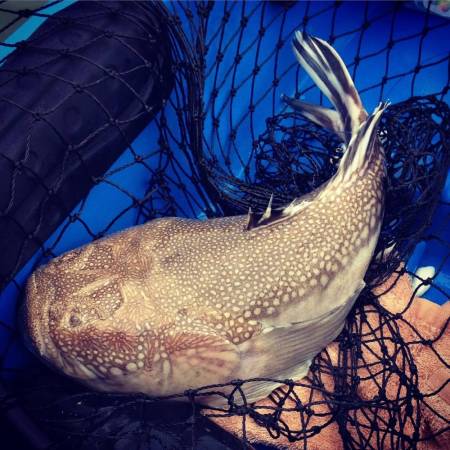
A Northern Stargazer caught in Worcester Co., Maryland
Photo by Nick Denny.
Northern stargazers call the temperate waters of the Atlantic coast and its bays home, ranging from North Carolina to New York. They are a benthic species, dwelling in sandy bottom habitats at depths up to 120 feet. They use their stout pectoral fins like sand shovels and can quickly bury themselves in just a few seconds to hide from predators. Thanks to the unique shape of the stargazer, the eyes and nostrils remain above the sand when the rest of the body is submerged in sandy camouflage, allowing them to see their prey and to breathe when buried. Most fish bring water in through their mouths to breathe, but stargazers uniquely inhale water through their nostrils before exhaling it through their gills. A curtain of fleshy, comb-shaped fringe covers the nostrils to keep out granules of sand and protect the nostrils.
Imagine being an unsuspecting minnow, perhaps a mummichog or bay anchovy, schooling a few inches over the bay bottom. You scan for predators but see nothing except an expanse of amber waves of sand grains. Before you are even aware of what is happening, a northern stargazer rises in a flash, creates a vacuum with its cavernous mouth to suck you in, and swallows you whole.
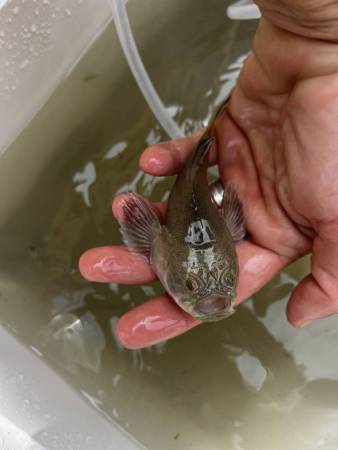
While the vacuum-powered mouth of the northern stargazer is quite impressive, its remarkable talents do not stop there. Stargazers have a special organ located behind their eyes that produces an electrical shock to defend against predators. The electrical currents the northern stargazer generates are relatively weak, but it is still advised to use caution when handling one of these creatures or else you could be in for a shocking experience. When we think of animals that possess the power of electricity, we think of electric eels deep in the Amazon, but we have them in our own backyard!
Our Coastal Bays serve as a nursery for juvenile stargazers. We get these little darlings for a few years while they take their time maturing in the inshore habitat of sandy bays. Next thing you know the little stargazer larvae have progressed through their juvenile years and are moving offshore to become adults. What parents say is true: they grow up so fast.
How fortunate we are to host such a fascinating species in the Coastal Bays. Northern stargazers are symbols of the awe-inspiring adaptations of nature and the unique variety of life that call our Bays home. If you are lucky enough to stumble across one, let it be a reminder to keep your eyes to the skies and aim for the stars.
About the Author: Brooke Eckert served as the Program and Communications Coordinator for the Maryland Coastal Bays Program from 2024-2025 and resides in Berlin, Maryland.