
“There is nothing to worry about with sharks. They have always been here and hopefully always will.” - Captain Mark Sampson
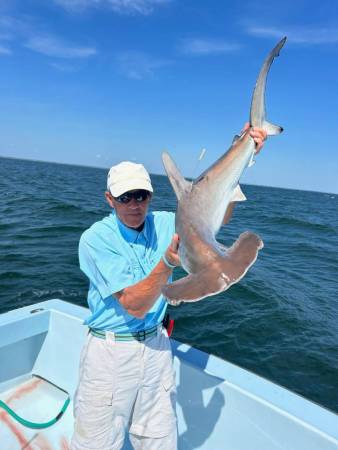
All are shared with permission by Captain Mark Sampson
Ocean City is famous for its beaches, boardwalk, inlet, and its world class fishing, but beneath the waves of the Atlantic Ocean and the Coastal Bays live a group of predators that have fascinated locals and visitors alike: sharks. While most people think of sharks as giants of the sea, several species regularly inhabit the waters around Ocean City and Assateague Island, playing important roles in maintaining healthy marine ecosystems.
To learn more about these remarkable creatures during my internship with the Maryland Coastal Bays Program, I spoke with local shark fisherman, Captain Mark Sampson. Captain Sampson has decades of experience on the water and provides firsthand experience on the sharks that call Maryland’s coast home. We talked about which species are found in our region, why they visit these waters, and what fisherman should know about recreational fishing for sharks. Ocean City is known as a premier fishing destination and is often called the White Marlin Capital of the World, making its surrounding waters an important habitat for a variety of marine species including sharks.
Since 1987, Captain Sampson has been a charter boat captain and fishing guide in Ocean City and the Florida Keys. For the past 39 years, Captain Sampson has kept fishing logs of every shark caught on his boat. Local researchers and government organizations like the Maryland Department of Natural Resources (MDNR) use these logs to look at trends in shark fisheries. Captain Sampson logs shark size shark, sex, life stage, and even a genetic sample in the form a fin clip off the dorsal fin of the shark. Captain Sampson also tags the shark with a unique number, so it can be tracked if recaptured. All sharks caught on Captain Sampson’s boat are handled under MDNR Scientific Research Permit and from National Marine Fisheries Service through an Exempted Fishing Permit.
You may be wondering what kind of sharks swim beneath the waves of Ocean City and Assateague Island. Based on Captain Sampson’s observations, the sharks found in Maryland’s Coastal Bays are sandbars, dusky, smooth dogfish, and the occasional sand tiger. These sharks come into the bays to use them as a nursery for their young, also known as pups. Pups range in size by species with the largest being 3-5 ft. The bays provide a safer environment for the pups to grow up in during the summer months before they swim out into the ocean.
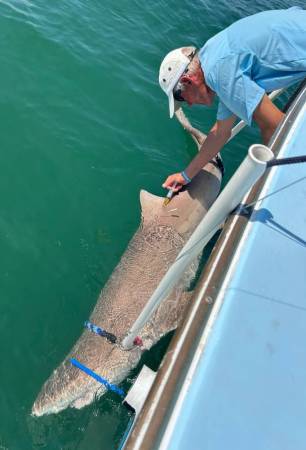
When asked about offshore shark diversity, Captain Sampson explained that waters just offshore Ocean City support a wide variety of shark species. Over the years, he has documented at least 14 different shark species found two miles off the shoreline. Some of the more notable species include thresher, blacktip, bull, and sand tiger sharks. Some species of sharks like the mako and blue are found 20 miles out. Great white sharks have also been encountered off of Maryland’s coast.
Beyond being powerful predators, sharks play a critical role in maintaining the balance and health of marine ecosystems. Captain Sampson explained that sharks are sometimes called “the garbage men of the sea.” They help keep the ocean and Coastal Bays in balance by removing sick and dying fish and preventing certain species, such as croakers and seatrouts, from becoming overly abundant. Captain Sampson also noted that shark populations along Maryland’s coast have changed over the years. While some species have become less common due to historical overfishing, regulations and catch restrictions have helped certain shark species begin to recover. One success story is that of the sand tiger shark. Captain Sampson explained that sand tigers were once commonly seen along Maryland’s coast, but overfishing caused their populations to decline significantly. After years of regulations and protective measures, the species is now slowly beginning to recover.
Do you know what to do if you catch a shark? As recreational shark fishing has become more popular in recent years, Captain Sampson emphasized that anglers must understand both proper shark identification and Maryland’s shark fishing regulations. Many shark species found off Ocean City and Assateague are protected and must be released immediately if caught. He explained that one of the biggest mistakes anglers make is mishandling sharks for photographs or removing them from the water unnecessarily. This can cause severe stress and injury to the animal while also creating dangerous situations for the fisherman. Smaller sharks are often underestimated and can still seriously injure someone if handled improperly.
Captain Sampson stressed that proper catch and release practices are essential for shark conservation. These include keeping the shark in the water whenever possible, minimizing handling time, and using proper dehooking tools. If a hook cannot safely be removed, anglers should cut the leader as close to the hook as possible and release the shark immediately.
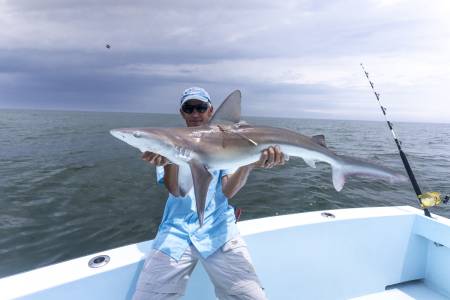
Maryland regulations also require anglers targeting sharks to use non offset, non-stainless-steel circle hooks and possess a device capable of quickly cutting the hook or leader. According to Maryland law, sharks that are being released may not be removed from the water and must be released in a manner that causes the least possible harm to the animal. Additional Maryland shark fishing regulations and species identification information can be found through the Maryland Department of Natural Resources regulations page.
Article by Colin O’Donnell, Seasonal Environmental Scientist with the Maryland Coastal Bays Program