
Creature Features
What is a Flounder’s Favorite Season? How Summer and Winter Flounder Are Different
By Maryland Coastal Bays ProgramAugust 4, 20214 min read
On this page
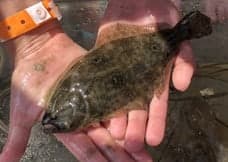
 Summer Flounder, Photo by Liz Wist (MCBP)
In many ways, flounder are similar to what we normally think of when we think of a fish. But, one big thing stands out – they are flat! Their flat shape is an adaptation to life on the bottom of the seafloor, where they lay motionless and covered with sand. That is, until, a meal comes along. When prey gets close to a flounder, it is typically quickly snatched, which is why they are labeled “ambush predators”. Their flat body benefits them in other ways too, since it allows them to be well camouflaged from predators like sharks and eels. And while their body shape and hiding strategies are enough to make them masters of camouflage, they can also change colors to match their surrounding environments.
Flounder are also a popular fish to catch, sought out by commercial and recreational fishermen alike. They can be found in very shallow and murky waters of near-shore estuaries, as well as waters that are much, much deeper. And despite the popularity of having these flatfish fried and served for dinner at your favorite seafood restaurant, most populations have stayed relatively stable over the years.
So back to winter and summer flounder – what the heck is the difference?
Summer Flounder, Photo by Liz Wist (MCBP)
In many ways, flounder are similar to what we normally think of when we think of a fish. But, one big thing stands out – they are flat! Their flat shape is an adaptation to life on the bottom of the seafloor, where they lay motionless and covered with sand. That is, until, a meal comes along. When prey gets close to a flounder, it is typically quickly snatched, which is why they are labeled “ambush predators”. Their flat body benefits them in other ways too, since it allows them to be well camouflaged from predators like sharks and eels. And while their body shape and hiding strategies are enough to make them masters of camouflage, they can also change colors to match their surrounding environments.
Flounder are also a popular fish to catch, sought out by commercial and recreational fishermen alike. They can be found in very shallow and murky waters of near-shore estuaries, as well as waters that are much, much deeper. And despite the popularity of having these flatfish fried and served for dinner at your favorite seafood restaurant, most populations have stayed relatively stable over the years.
So back to winter and summer flounder – what the heck is the difference?
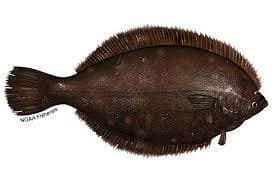 Winter Flounder, Photo from NOAA species directory
At a quick glance, it doesn’t look like there is much of a difference at all. However, there are a few easy indicators to help you out. The biggest difference between the two is what side their eyes shift to when they transform from larvae into juvenile fish. The eyes of summer flounder shift to the left side of their body, while the eyes of winter flounder shift to the right.
Winter Flounder, Photo from NOAA species directory
At a quick glance, it doesn’t look like there is much of a difference at all. However, there are a few easy indicators to help you out. The biggest difference between the two is what side their eyes shift to when they transform from larvae into juvenile fish. The eyes of summer flounder shift to the left side of their body, while the eyes of winter flounder shift to the right.
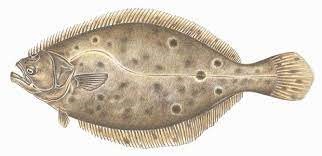 Summer Flounder (Fluke), Photo from Commonwealth of Massachusetts
At this point you’re probably thinking, “They’re flat? How can I tell which way is which?”. When placed with their dorsal fin (the fin on the top of their body) upright, their mouth will be angled upright and their eyes will be slightly above their mouth.
There are also slight color differences between the two. Winter flounder tend to be a darker shade of brown than summer flounder, which also have ringed eyespots along the top side of their body. At least five of these eyespots will form an “X”, making the summer flounder look like the 5-side of a die. Summer flounder tend to grow larger than winter flounder, growing up to 3 feet, while winter flounder can only grow to about 2 feet. A summer flounder, in comparison to a winter flounder of the same size, will also have a much larger, toothier mouth, making them look like the older, more intimidating cousin of the winter flounder.
Summer Flounder (Fluke), Photo from Commonwealth of Massachusetts
At this point you’re probably thinking, “They’re flat? How can I tell which way is which?”. When placed with their dorsal fin (the fin on the top of their body) upright, their mouth will be angled upright and their eyes will be slightly above their mouth.
There are also slight color differences between the two. Winter flounder tend to be a darker shade of brown than summer flounder, which also have ringed eyespots along the top side of their body. At least five of these eyespots will form an “X”, making the summer flounder look like the 5-side of a die. Summer flounder tend to grow larger than winter flounder, growing up to 3 feet, while winter flounder can only grow to about 2 feet. A summer flounder, in comparison to a winter flounder of the same size, will also have a much larger, toothier mouth, making them look like the older, more intimidating cousin of the winter flounder.
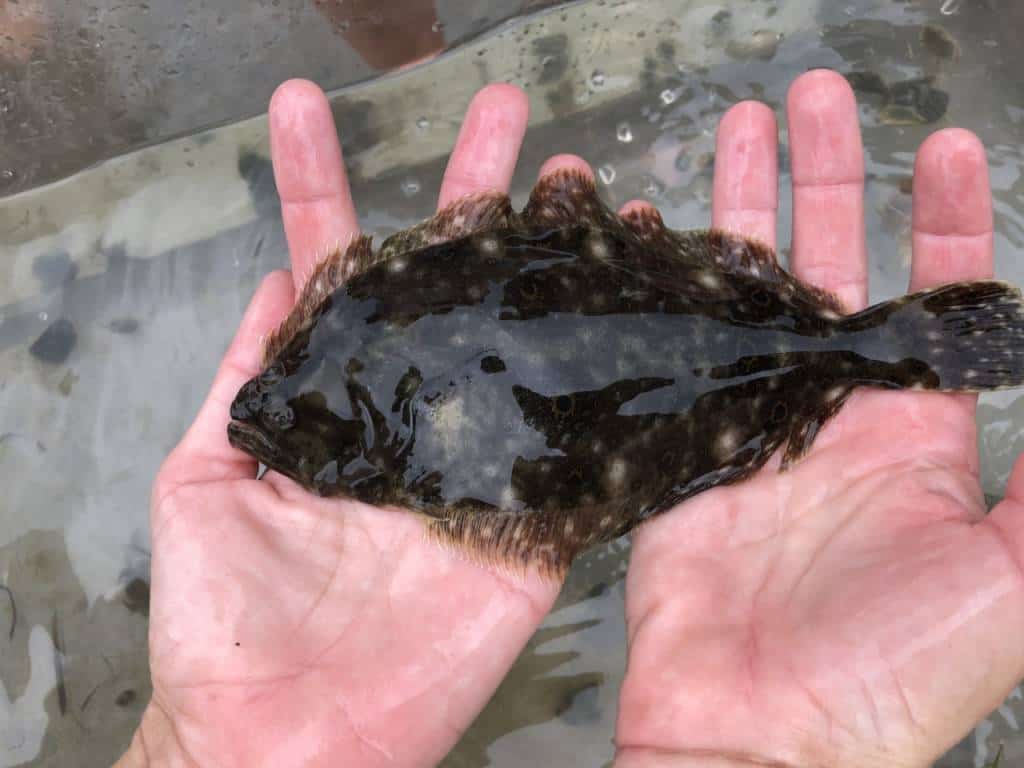
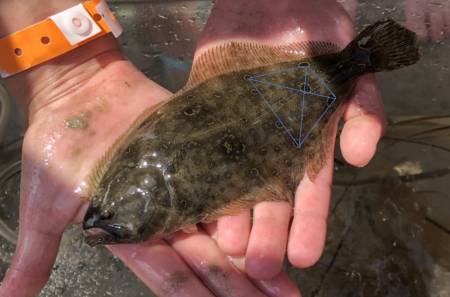 The blue lines mark the "X" of the eyespots on a Summer Flounder found in Maryland's Coastal Bays. Photo by MCBP
In our Coastal Bays, it is much more common to see summer flounder, since their normal range is from Massachusetts down to North Carolina. Winter flounder are commonly found north of the Delaware Bay up to Canada, but they find their way into our bays every now and then during the winter months. It is much less common to see winter flounder in the summer months when they migrate more north or into deeper waters.
The blue lines mark the "X" of the eyespots on a Summer Flounder found in Maryland's Coastal Bays. Photo by MCBP
In our Coastal Bays, it is much more common to see summer flounder, since their normal range is from Massachusetts down to North Carolina. Winter flounder are commonly found north of the Delaware Bay up to Canada, but they find their way into our bays every now and then during the winter months. It is much less common to see winter flounder in the summer months when they migrate more north or into deeper waters.
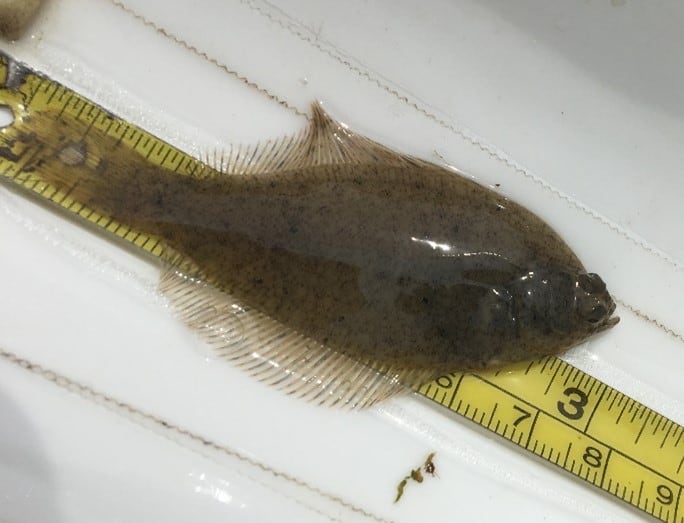 Black Back (Winter Flounder), Photo by MCBP
And, just to keep you hip with some different lingo you might hear, winter flounder are commonly referred to as black backs, while summer flounder are known as flukes or northern flounder (in contrast to the southern flounder, which reside in the southeast U.S. and Gulf of Mexico).
So if, in the future, you happen to hook a flounder or see one near shore (despite their fantastic camouflage), ask yourself: “What’s this flounder’s favorite season?”.
Black Back (Winter Flounder), Photo by MCBP
And, just to keep you hip with some different lingo you might hear, winter flounder are commonly referred to as black backs, while summer flounder are known as flukes or northern flounder (in contrast to the southern flounder, which reside in the southeast U.S. and Gulf of Mexico).
So if, in the future, you happen to hook a flounder or see one near shore (despite their fantastic camouflage), ask yourself: “What’s this flounder’s favorite season?”.
Author Background
Cailyn Joseph is a summer intern with the Maryland Coastal Bays Program. Cailyn works with both the science and education teams on programs such as wetland assessments, data entry, summer camp facilitation, lesson design, bird monitoring, public seining programs, and more. Cailyn graduated from Salisbury University in May 2021 with a B.A. in environmental studies and a B.S. in biology.About Maryland Coastal Bays Program
All Creature Features are written by a Maryland Coastal Bays Program (MCBP) staff member. MCBP is a non-profit and National Estuary Program that exists to protect and conserve the waters and surrounding watershed of Maryland’s coastal bays to enhance their ecological values and sustainable use for both present and future generations. MCBP works with stakeholders on the local, state, and federal level to protect the five main bays within the watershed; Assawoman, Isle of Wight, Sinepuxent, Newport, and Chincoteague, through restoration, environmental education, scientific monitoring, and targeted community outreach.
Get Ocean City in your inbox
Updates, events, and deals — delivered weekly. No spam, unsubscribe anytime.
From visitors
Comments
Have something to add? Drop a comment below.
Be the first to share your experience.