
Creature Features
The Always Original Osprey
By Maryland Coastal Bays ProgramJuly 9, 20223 min read
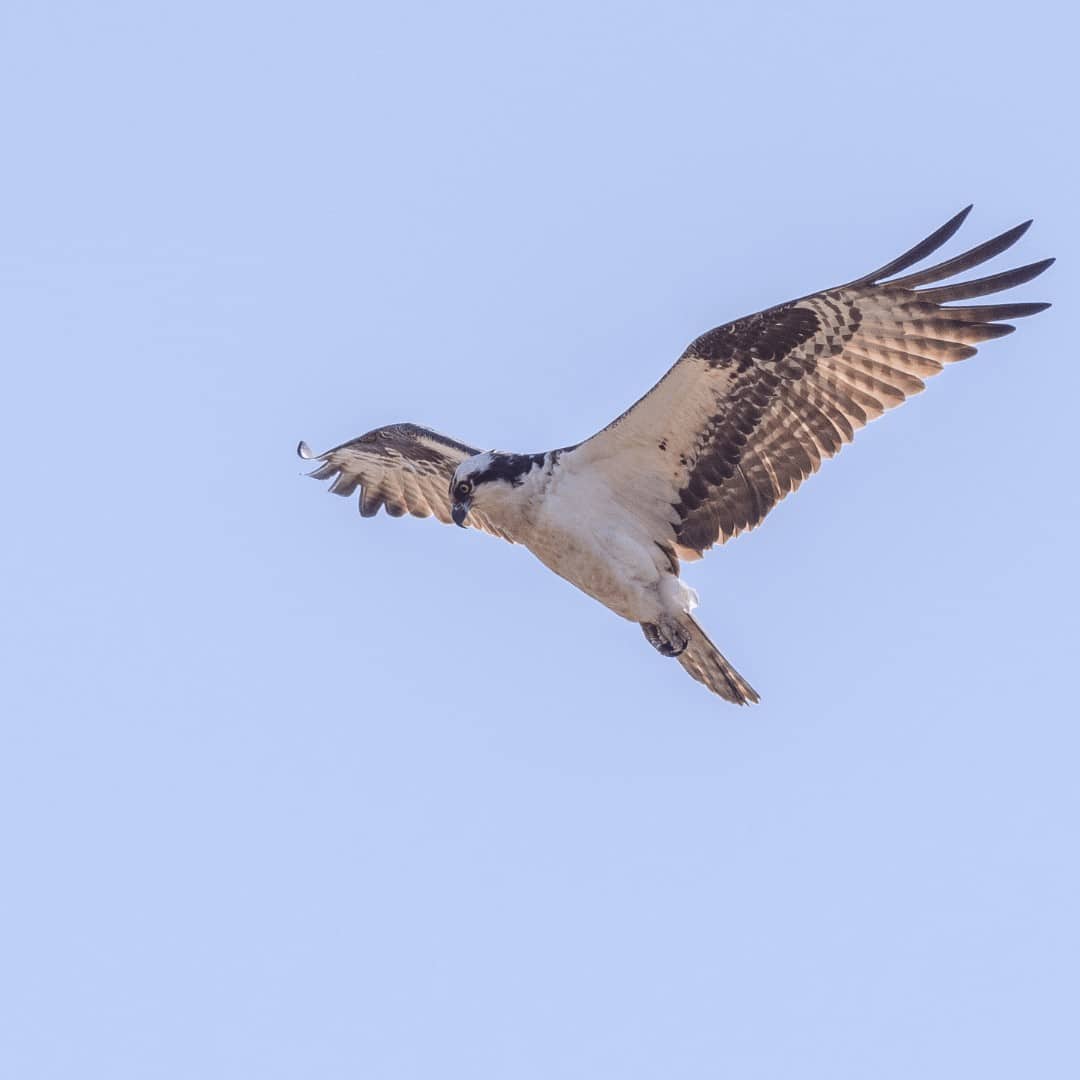
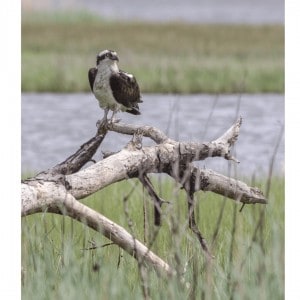 Osprey on branch by Logan Hall
Most ospreys migrate yearly, breeding in the north and wintering in the south. They build nests from sticks and other smaller materials in large piles on dead trees and other surfaces that are close to water and open to the sky. Ospreys usually lay three eggs for the year and males and females share parental duties incubating them. The chicks hatch at different times so the older ones have a size and strength advantage over their younger siblings. If the family falls on hard times and food is in short supply the bigger birds will often take it all for themselves, leaving the younger ones to perish.
Hunting
Ospreys are gifted fishers that hunt by soaring over the water, scanning for fish near the surface, then plunging down 30 to 100 ft talon first to snatch their prey up. They even take care to orient the fish with their head forward for more aerodynamic flight while carrying them. Now that’s what I call efficiency! Eagles are the natural rival of ospreys and are known to hassle ospreys to force them to drop their fish and rob them of their hard-earned catch.
Osprey on branch by Logan Hall
Most ospreys migrate yearly, breeding in the north and wintering in the south. They build nests from sticks and other smaller materials in large piles on dead trees and other surfaces that are close to water and open to the sky. Ospreys usually lay three eggs for the year and males and females share parental duties incubating them. The chicks hatch at different times so the older ones have a size and strength advantage over their younger siblings. If the family falls on hard times and food is in short supply the bigger birds will often take it all for themselves, leaving the younger ones to perish.
Hunting
Ospreys are gifted fishers that hunt by soaring over the water, scanning for fish near the surface, then plunging down 30 to 100 ft talon first to snatch their prey up. They even take care to orient the fish with their head forward for more aerodynamic flight while carrying them. Now that’s what I call efficiency! Eagles are the natural rival of ospreys and are known to hassle ospreys to force them to drop their fish and rob them of their hard-earned catch.
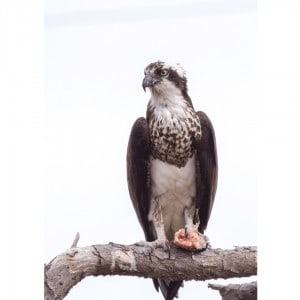 Osprey perching by Logan Hall
Threats and Conservation Efforts
With widespread application of DDT and other pesticides in the 50s, osprey populations in North America declined and became endangered. DDT interferes with the bird’s calcium metabolism which led to them laying eggs with thin shells, too fragile to survive or infertile from the beginning. After several osprey-harming pesticides were banned in 1972, osprey populations rebounded significantly.
Ospreys are also dealing with habitat loss due to human development. At the same time, human development can create places for ospreys to nest on such as on poles, channel markers, duck blinds, and other structures. Ever noticed those tall man-made platforms in and around the water? Chances are that was an osprey-nesting platform. Many property owners near large bodies of water have constructed these to encourage ospreys to nest and help strengthen the local population.
Uncertain future
Global climate change contributes to increasingly severe spring heat waves that endanger young ospreys still in the nest. Changing temperatures are already having observable impacts on many birds’ migration timing and geographical range. According to the Audubon Society, ospreys may lose 79 percent of their summer range by 2080.
Osprey perching by Logan Hall
Threats and Conservation Efforts
With widespread application of DDT and other pesticides in the 50s, osprey populations in North America declined and became endangered. DDT interferes with the bird’s calcium metabolism which led to them laying eggs with thin shells, too fragile to survive or infertile from the beginning. After several osprey-harming pesticides were banned in 1972, osprey populations rebounded significantly.
Ospreys are also dealing with habitat loss due to human development. At the same time, human development can create places for ospreys to nest on such as on poles, channel markers, duck blinds, and other structures. Ever noticed those tall man-made platforms in and around the water? Chances are that was an osprey-nesting platform. Many property owners near large bodies of water have constructed these to encourage ospreys to nest and help strengthen the local population.
Uncertain future
Global climate change contributes to increasingly severe spring heat waves that endanger young ospreys still in the nest. Changing temperatures are already having observable impacts on many birds’ migration timing and geographical range. According to the Audubon Society, ospreys may lose 79 percent of their summer range by 2080.
 Osprey with a fish by Liz Wist, MCBP
The only hope to protect these magnificent raptors against this growing threat is for humans to take action to reduce greenhouse gas emissions substantially and slow down the rate of global average surface temperature rise.
About the Author
Christy Ferguson is a summer intern with the Maryland Coastal Bays Program and recent graduate from the University of Maryland Baltimore County with a BS in environmental science and geography. This summer she will be assisting with water quality monitoring, restoration monitoring, wetland assessments, seining at Castaways, and Ocean City Estuary Explorers camp. Christy loves getting to see new wildlife species out in the wild and learning to identify them.
Osprey with a fish by Liz Wist, MCBP
The only hope to protect these magnificent raptors against this growing threat is for humans to take action to reduce greenhouse gas emissions substantially and slow down the rate of global average surface temperature rise.
About the Author
Christy Ferguson is a summer intern with the Maryland Coastal Bays Program and recent graduate from the University of Maryland Baltimore County with a BS in environmental science and geography. This summer she will be assisting with water quality monitoring, restoration monitoring, wetland assessments, seining at Castaways, and Ocean City Estuary Explorers camp. Christy loves getting to see new wildlife species out in the wild and learning to identify them.About Maryland Coastal Bays Program
All Creature Features are written by a Maryland Coastal Bays Program (MCBP) staff member. MCBP is a non-profit and National Estuary Program that exists to protect and conserve the waters and surrounding watershed of Maryland’s coastal bays to enhance their ecological values and sustainable use for both present and future generations. MCBP works with stakeholders on the local, state, and federal level to protect the five main bays within the watershed; Assawoman, Isle of Wight, Sinepuxent, Newport, and Chincoteague, through restoration, environmental education, scientific monitoring, and targeted community outreach.
Get Ocean City in your inbox
Updates, events, and deals — delivered weekly. No spam, unsubscribe anytime.
From visitors
Comments
Have something to add? Drop a comment below.
Be the first to share your experience.