
News
Creature Feature: Royal Tern
By Maryland Coastal Bays ProgramMay 21, 20202 min read
On this page
Coastal Bays Islands; They’re For the Birds!
Creature Feature: Royal Tern
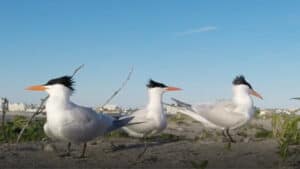 photo credit: Dave Brinker,DNR
While out boating, or enjoying a walk along the bay, you may have seen a bird hover over the water, then quickly dive and emerge with a wiggly fish in its beak. Most likely, this was a royal tern, and they great fun to watch. Royal terns are found in most coastal areas and make extensive annual migrations from the mid-Atlantic to Central and South America. Maryland is around the northern extent of their breeding range, and unfortunately, these birds are in trouble.
photo credit: Dave Brinker,DNR
While out boating, or enjoying a walk along the bay, you may have seen a bird hover over the water, then quickly dive and emerge with a wiggly fish in its beak. Most likely, this was a royal tern, and they great fun to watch. Royal terns are found in most coastal areas and make extensive annual migrations from the mid-Atlantic to Central and South America. Maryland is around the northern extent of their breeding range, and unfortunately, these birds are in trouble.
Eggs are vulnerable
Since royal terns live along coastal areas, they have evolved a habit of laying their eggs in shallow depressions on bare sand between the high tide line and the coastal grasses. Their eggs are sand colored and the birds nest in large colonies which helps to keep predators away. Beaches are their ideal nesting area, however, shoreline development has driven the birds to nest on isolated islands. But island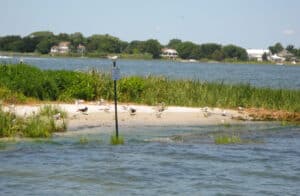 photo credit: Dr. Roman Jesien,MCBP
nesting can be treacherous. Storms with high water levels can wash away nests, and sea level rise and erosion have greatly reduced the number of islands in the coastal bays. In fact, almost 300 acres of our island habitat have been lost in the past 25 years.
Because of island loss, numbers of royal tern breeding pairs have dropped drastically over the years. Royal terns, and the other birds that nest on the ground on the islands such as common terns and black skimmers, are now listed as endangered in Maryland, and the coastal bays are the only place in Maryland these birds breed. So, the islands that still exist in our local bays are extremely important for these birds.
photo credit: Dr. Roman Jesien,MCBP
nesting can be treacherous. Storms with high water levels can wash away nests, and sea level rise and erosion have greatly reduced the number of islands in the coastal bays. In fact, almost 300 acres of our island habitat have been lost in the past 25 years.
Because of island loss, numbers of royal tern breeding pairs have dropped drastically over the years. Royal terns, and the other birds that nest on the ground on the islands such as common terns and black skimmers, are now listed as endangered in Maryland, and the coastal bays are the only place in Maryland these birds breed. So, the islands that still exist in our local bays are extremely important for these birds.
How you can help the royal tern
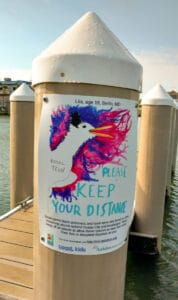 photo credit: Dr. Roman Jesien,MCBP
What you can do is please stay off the islands during the summer months. These birds should not be disturbed while they are nesting, and the public’s cooperation is of the utmost importance. Due to the quarantine, warning signs have not put out on the islands yet, so please be aware and keep your distance. Help us help the birds!
photo credit: Dr. Roman Jesien,MCBP
What you can do is please stay off the islands during the summer months. These birds should not be disturbed while they are nesting, and the public’s cooperation is of the utmost importance. Due to the quarantine, warning signs have not put out on the islands yet, so please be aware and keep your distance. Help us help the birds!
About the MCBP contributor
Dr. Roman Jesien is the Science Coordinator at the Maryland Coastal Bays Program. Since 2002, he has been the technical lead for science and restoration-related programs and projects throughout the coastal bays watershed.About Maryland Coastal Bays Program
All Creature Features are written by a Maryland Coastal Bays Program (MCBP) staff member. MCBP is a non-profit and National Estuary Program that exists to protect and conserve the waters and surrounding watershed of Maryland’s coastal bays to enhance their ecological values and sustainable use for both present and future generations. MCBP works with stakeholders on the local, state, and federal level to protect the five main bays within the watershed; Assawoman, Isle of Wight, Sinepuxent, Newport, and Chincoteague, through restoration, environmental education, scientific monitoring, and targeted community outreach.
Get Ocean City in your inbox
Updates, events, and deals — delivered weekly. No spam, unsubscribe anytime.
From visitors
Comments
Have something to add? Drop a comment below.
Be the first to share your experience.